
About a year ago, I wrote a piece called You Don't Own 500 Companies. One of the takeaways was the importance of global diversification. The idea was simple: diversifying investments across global markets and sticking to a disciplined rebalancing strategy helps reduce risk and, historically, has enhanced portfolio returns.
Fast forward to 2025 and that principle held strong. The S&P 500 had another exceptional year with a 17.9% return, but guess what? International and Emerging Market equities did even better. No one had that on their bingo card for 2025.
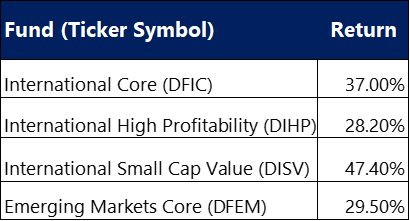
Capturing these unexpected returns wasn’t luck, rather, it’s a feature of our disciplined process. We never have the luxury of knowing in advance when outsized returns will arrive, which is why the system and process matter. It requires patience and discipline to stay in your seat. And in 2025, patience was rewarded.
The truth is global diversification will always feel uncomfortable. It means continually owning asset classes that aren’t “hot” at the moment. FOMO will set in. Human nature won’t help, as we are biologically hardwired to pursue pleasure and avoid pain. It’s a survival skill rooted in all of us. But successful investing often means doing the opposite: rebalancing out of what’s currently hot (the pleasure) and buying more of what’s lagging (the pain). That’s strategic rebalancing.
Even in 2024, that meant shifting money back into International and Emerging Market equities while the U.S. market was outperforming. Many clients asked us, “Why own International holdings that are underperforming the S&P 500?” By staying disciplined to our processes, we locked in some gains from U.S. stocks in late 2024 and reinvested in areas that were underperforming relative to the US.
As a result, our globally diversified equity portfolio (led by International and Emerging Markets) outperformed the stellar performance of the S&P 500 by about 3% in 2025.
And today? We are doing the reverse. We are selling some International and Emerging Market positions, locking in gains, and rebalancing portfolios into asset classes that have not performed as well.
Odds Favor the House
It’s not about chasing big wins, rather it’s consistently participating in small gains through the long-term process. It’s about being the house, not the player. In Vegas, the casino doesn’t rely on a few lucky hands; it wins by applying a consistent, proven system that captures small, steady, repeatable gains over time. The odds are always in the house’s favor over the long-term. That’s the same principle behind disciplined investing: implementing a repeatable long-term process instead of gambling on short-term speculation. Those incremental wins compound, creating potential long-term wealth while avoiding the boom-or-bust cycle of chasing market returns.
Investing for the future is a journey. It’s a story that isn’t told in a day, a month or a year. Keeping that in mind is a sound first step for the new year.
Sources (Dimensional Fund Advisors)
Returns shown are for the 2025 calendar year. Pastperformance is not a guarantee of future results. Investment values willfluctuate, and investors may lose money. Please refer to each fund’sstandardized performance and prospectus for additional details.